Guides · Flagler Beach, Florida
Flagler Beach Water, Sand & Pier: What to Know
Flagler Beach’s six miles of coquina-orange sand and its single pier are not just scenery. They are the reason the town has stayed low-rise and unhurried. The water shaped its history, its housing, its monthly rhythms.
The Color of the Sand and What It Says
The sand here is orange. That is not a trick of the light. Crushed coquina shell, ground fine by the Atlantic over centuries, gives Flagler Beach a colour no other stretch of Florida coast has. Drive north or south and the sand turns pale, beige, ordinary. Here it holds a warm, rusted tint that shifts with the hour — deeper at dusk, almost apricot at noon. The coquina is the town’s first statement, made before any building permit was filed: this place is different, and it shows it on the surface. Visitors often stop, stoop, and scoop a handful, checking that it is real. It is.
One Pier, Not a Row of Them
Six miles of sand, interrupted once. That is the whole geography. The fishing pier, built decades ago and rebuilt after storms, stands as the only break in the shoreline. No second pier, no third. Other towns on this coast string them like beads; Flagler Beach kept one. That single structure functions as the town’s gathering point — anglers at the rail, walkers at sunset, children leaning over the edge to watch the water below. It is not a commercial boardwalk with shops and arcades. It is a working pier, a place to stand over the water and feel the town’s pace. One pier, not a row of them, is the whole argument.
A Town That Said No to High-Rises
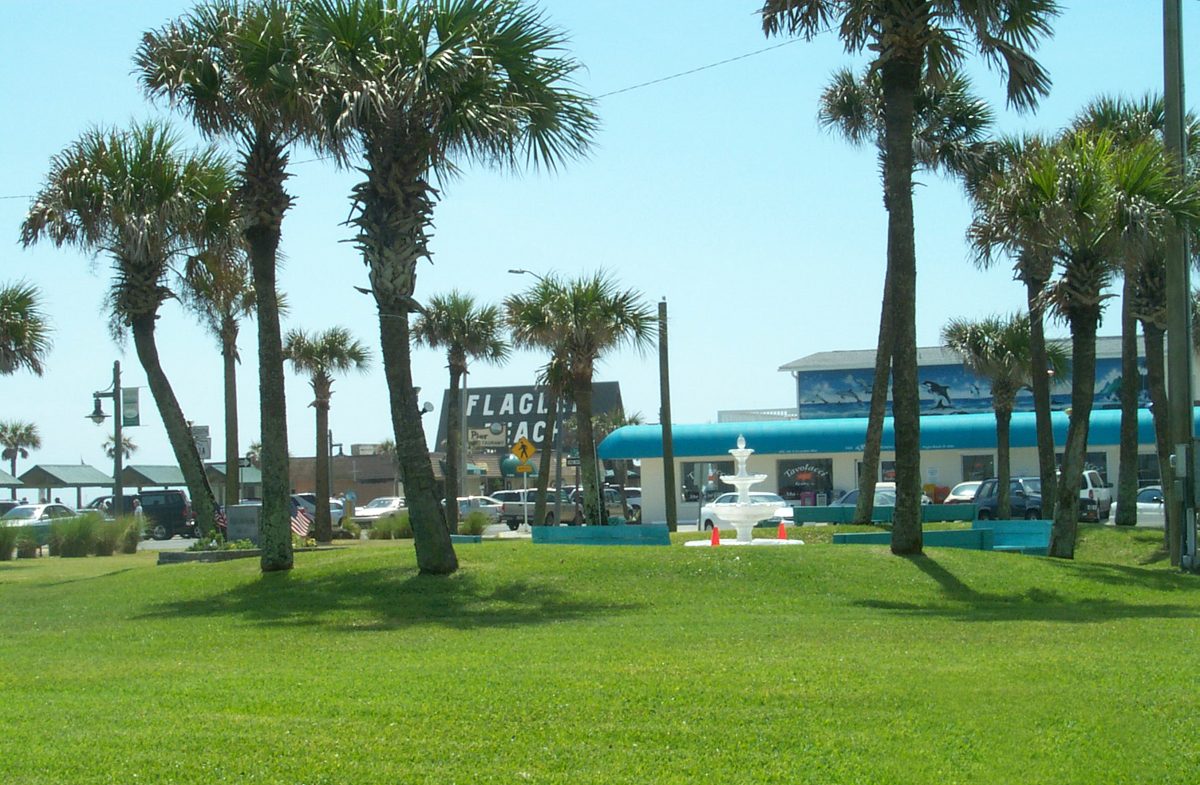
Flagler Beach was incorporated on 16 April 1925, named for Henry Flagler, the oil and railroad magnate who did more than anyone to turn Florida’s east coast into a resort. But the town that carries his name did not follow his blueprint of grand hotels and dense development. It stayed low-rise, unincorporated in feel, deliberately undeveloped next to its neighbours. No high-rises shadow the sand. The buildings step back, the skyline stays flat, and the beach remains the tallest thing on the horizon. That resistance is not accidental; it is the town’s identity, written in zoning and reinforced by people who preferred quiet over crowds. Neighbouring Palm Coast, nine miles away, offers its own charms — the Creekside Music & Arts Festival, for one — but it builds differently. Flagler Beach built less on purpose.
The Water’s Pull on Daily Life
The water does not just sit at the edge of town; it anchors the calendar. On the first Friday of every month, from 6pm to 9pm, Veterans Park on South 2nd Street fills with music and local vendors. The beach is one block away. You can hear the waves between songs. This is not a festival imported from elsewhere; it is a local rhythm, unhurried and repeatable. Families wander, neighbours talk, the pier lights come on, and the ocean keeps its steady percussion. The town’s monthly pulse is set by that proximity — the water is never far from the conversation, the music, or the evening air.
Who Lives Here Now: A Snapshot in Numbers
The census tells a story of a small, settled place. Population: 5,250 people. Median age: 58.8 years — a town that skews older, quieter, more established. Housing reflects that character. The median home value is $496,800, and the median gross rent is $1,581. But the notable figures are the empty ones: out of 3,538 total housing units, 1,019 are vacant, and 795 are held for seasonal or recreational use. A significant share of homes are not year-round. The town empties out between seasons. Unemployment sits at 2.9 percent, and median household income is $81,193, with 35.5 percent of residents holding a bachelor’s degree or higher. These are not the numbers of a boomtown; they are the numbers of a place that values space, solitude, and surf.
| Measure | Figure |
|---|---|
| Population | 5,250 |
| Median age | 58.8 years |
| Total housing units | 3,538 |
| Seasonal or recreational homes | 795 |
| Vacant housing units | 1,019 |
| Median home value | $496,800 |
| Median gross rent | $1,581 |
| Median household income | $81,193 |
| Bachelor’s degree or higher | 35.5% |
| Unemployment rate | 2.9% |
Remembering the Water’s History
The Flagler Beach Historical Museum holds the town’s story, from its 1925 incorporation to the storms, the pier rebuilds, and the families who stayed. A modest building for a modest place, but it does the work of memory — photographs of the early beach, records of the railroad magnate whose name the town carries, and the long record of people who came for the water and decided to stay. The museum is not a large attraction; it is a keeper of context. It reminds visitors that this orange sand and single pier were not always here, but they have been here long enough to define a place. The water shaped everything — the town’s founding, its resistance to development, its slow rhythms. The museum makes sure that is not forgotten.
Common questions
- Why is the sand in Flagler Beach orange?
- The sand is orange because it's made of crushed coquina shell. This gives Flagler Beach a color no other stretch of Florida coast has, across six miles of beach broken only by a single fishing pier.
- Is Flagler Beach crowded or developed like other Florida beaches?
- No. Flagler Beach is deliberately undeveloped compared with its neighbors. It's low-rise and unincorporated in feel, with about 5,250 residents. The town resisted what its neighbors did, so you won't find high-rise resorts here.
- What is there to do in Flagler Beach besides the beach?
- You can visit the Flagler Beach Historical Museum or walk the fishing pier, the only interruption in six miles of sand. On the first Friday of each month, from 6pm to 9pm, there's a free event at Veterans Park on South 2nd Street with music and local vendors.
- Is Flagler Beach a good place to live or retire?
- The median age is 58.8 years, and the median home value is $496,800. The unemployment rate is low at 2.9%, and median household income is $81,193. Many homes are for seasonal use—795 of 3,538 units—so it's a mix of full-time and part-time residents.
- How far is Flagler Beach from other towns with events?
- Palm Coast is 9 miles away, Sanford is 48 miles, Oviedo is 56 miles, Mount Dora is 57 miles, and Altamonte Springs is 59 miles. These towns host events like the Creekside Music & Arts Festival, Sanford Porchfest, and Mount Dora Arts Festival.
- When was Flagler Beach founded and who was it named after?
- Flagler Beach was incorporated on April 16, 1925. It's named for Henry Flagler, the oil and railroad magnate who did more than anyone to turn Florida's east coast into a resort. The town was built as a beach town and still is one.
Every business named above is one we hold a listing for, and every date traces to a source on our sources page. We do not describe menus, interiors or service we have not verified. Details change — confirm before you travel.