Guides · Flagler Beach, Florida
Flagler Beach History: The Industry That Built It
Flagler Beach was incorporated on 16 April 1925. The railroad baron whose name it carries never intended it to be anything but a place to stop and stay.
How Henry Flagler's Railroad Created Flagler Beach
Henry Flagler did more than anyone to turn Florida's east coast into a resort. His Florida East Coast Railway pushed south through the state in the late 19th and early 20th centuries. Flagler Beach sits where it does because of that push. The town took his name at incorporation in 1925, but it was built as a destination, not a port. There was no deep-water harbour to be had here, no industrial reason for the railroad to stop. The reason was the sand itself, and the sea in front of it.
What Flagler's railroad made possible—easy travel for people who wanted to see the ocean—became the town's only industry. A century later, that is still mostly true. The railroad is gone from daily life here, but the town it named has not needed to find another reason to exist.
Flagler Beach's Orange Sand and Undeveloped Shoreline
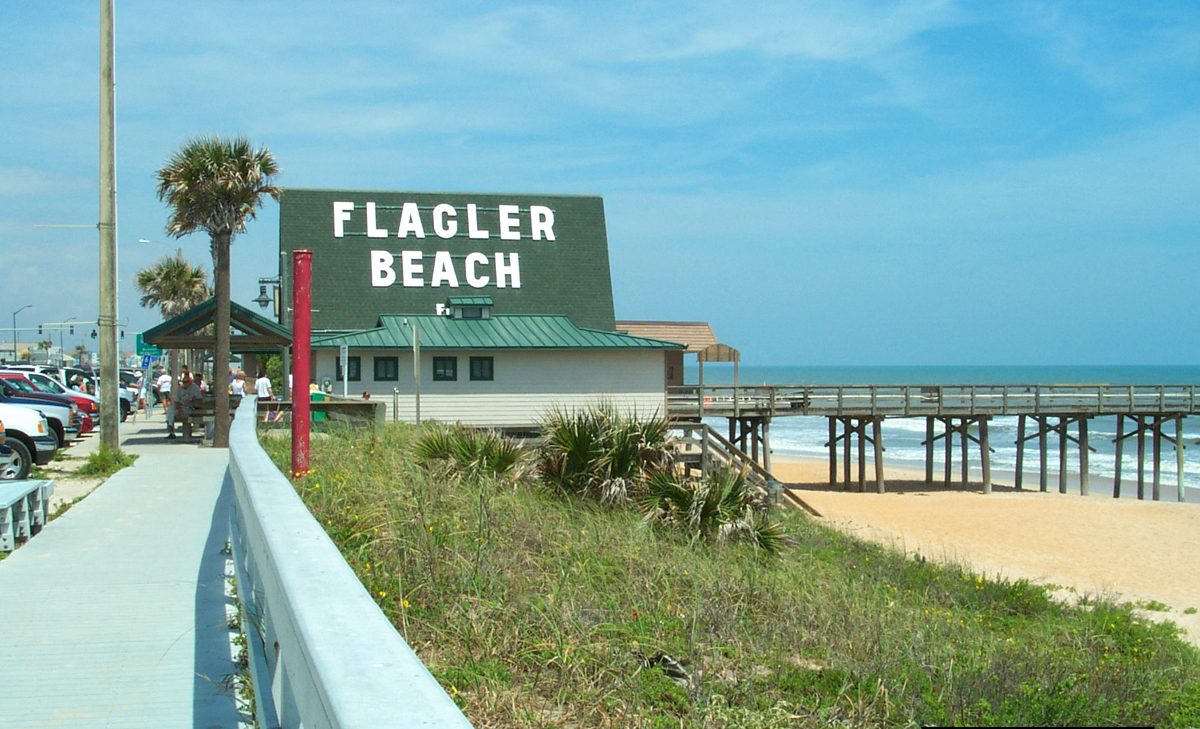
The sand is orange because it is crushed coquina shell. No other stretch of Florida coast has this colour, and it runs for six miles without interruption, except for one fishing pier. That pier is the only thing that breaks the line of sand. It is not a concession to development; it is a place to stand over the water.
The physical layout is a choice. Where other coastal towns in the region have filled their shorelines with towers and condominiums, Flagler Beach stayed low-rise and, in feel, almost unincorporated. You can see the water from the road, which is not something every beach town can say. The undeveloped character is not a failure to keep up. It is a refusal.
Flagler Beach Demographics: A Snapshot of a Seasonal Town
The census data draws a clear picture. Flagler Beach has 5,250 people and a median age of 58.8 years. The median home value is $496,800, and the median gross rent is $1,581 a month. Median household income is $81,193. Just over a third of adults—35.5 percent—hold a bachelor's degree or higher.
The unemployment rate is 2.9 percent, which sounds healthy until you look at what people actually do here. There are 3,538 total housing units. Of those, 1,019 are vacant, and 795 are held for seasonal or recreational use. Add those together and you find that more than half the housing stock is not occupied year-round by permanent residents.
Why Flagler Beach Embraces Its Seasonal Economy
The 795 seasonal homes and the 1,019 vacant units are not a problem the town is trying to solve. They are the point. Flagler Beach has a rhythm: quiet for most of the year, with a pulse of activity when the seasonal residents return. That is a different model from the more resort-driven neighbours to the south, where the entire economy is built around constant turnover.
| Flagler Beach at a Glance | |
|---|---|
| Measure | Figure |
| Population | 5,250 people |
| Median age | 58.8 years |
| Total housing units | 3,538 units |
| Seasonal or recreational use homes | 795 units |
| Vacant housing units | 1,019 units |
| Median home value | $496,800 |
| Median gross rent | $1,581 |
| Median household income | $81,193 |
| Bachelor's degree or higher | 35.5 percent |
| Unemployment rate | 2.9 percent |
Living here is not cheap. The gap between the median income and the median home value is stark, and rent is not far behind. The people who can afford to buy in Flagler Beach are often past their working years. The people who work here—the ones serving coffee and fixing roofs and teaching school—are increasingly priced out of the town they serve.
A Working-Class Past, a Retirement Present
The railroad era gave Flagler Beach a working-class character. The people who came to build the line, to maintain it, to work the docks that never materialised—they were not wealthy. The town has always been more modest than the grand resorts Flagler built further south.
Today, the economy has shifted. Low unemployment suggests everyone who wants a job has one, but the jobs available in a small beach town do not typically pay enough to buy a $496,800 home. The Flagler Beach Historical Museum preserves the memory of the earlier era, when the town was younger and rougher and the railroad was the reason anyone knew the name at all.
The median age of 58.8 years tells the rest of the story. This is a town where people come to retire, not to start a career. The children who grew up here often cannot afford to stay. The seasonal residents are not invaders; they are part of the design. But the design has consequences.
Keeping the Beach for the People Who Stay
Once a month, the town gathers at Veterans Park on South 2nd Street for First Friday. It runs from 6pm to 9pm, it is free, and it features music, local vendors, and the beach a block away. It is a small thing, deliberately so. No fireworks, no carnival, no attempt to draw crowds from Palm Coast or Daytona.
This is the civic ritual that reinforces the town's identity. It is unhurried. It is low-rise. It is for the people who are here, not for an imagined audience of tourists who might come if only the town tried harder.
Flagler Beach resisted what its neighbours did. The railroad built it, the sand defines it, and the people who stay here have decided, repeatedly, that they do not want it to be anything else. Six miles of orange sand, one pier, and a town that knows exactly what it is.
Common questions
- Why is the sand in Flagler Beach orange?
- Crushed coquina shell gives the sand its orange color. It's a shade no other stretch of Florida's coast has, across six miles of beach broken only by a single fishing pier. That's what makes this town's shoreline distinctive.
- When was Flagler Beach founded?
- Flagler Beach was incorporated on 16 April 1925. It's named for Henry Flagler, the oil and railroad magnate who did more than anyone to turn Florida's east coast into a resort. The town has stayed low-rise and deliberately undeveloped since.
- Is Flagler Beach a good place to live or just a tourist spot?
- It's a real beach town with 5,250 residents, a median age of 58.8, and a low 2.9 percent unemployment rate. Median household income is $81,193, and 35.5 percent of adults hold a bachelor's degree or higher. It feels unincorporated and unhurried.
- What is there to do in Flagler Beach?
- You can walk the six miles of orange sand, fish off the pier, or visit the Flagler Beach Historical Museum. On the first Friday of every month, from 6pm to 9pm at Veterans Park on South 2nd Street, there's free music and local vendors, with the beach a block away.
- How crowded or built-up is Flagler Beach compared to nearby towns?
- It's low-rise and deliberately undeveloped compared with its neighbors. Of 3,538 total housing units, 795 are for seasonal or recreational use, and 1,019 are vacant. Median home value is $496,800, and median gross rent is $1,581—so it's not a high-rise resort scene.
- What's the best way to spend a day in Flagler Beach?
- Start on the sand—six miles of coquina-orange beach with one pier interrupting it. Then walk to the historical museum or grab a spot at Veterans Park on a First Friday evening. For a change of pace, Palm Coast is 9 miles away for the Creekside Music & Arts Festival.
Every business named above is one we hold a listing for, and every date traces to a source on our sources page. We do not describe menus, interiors or service we have not verified. Details change — confirm before you travel.